
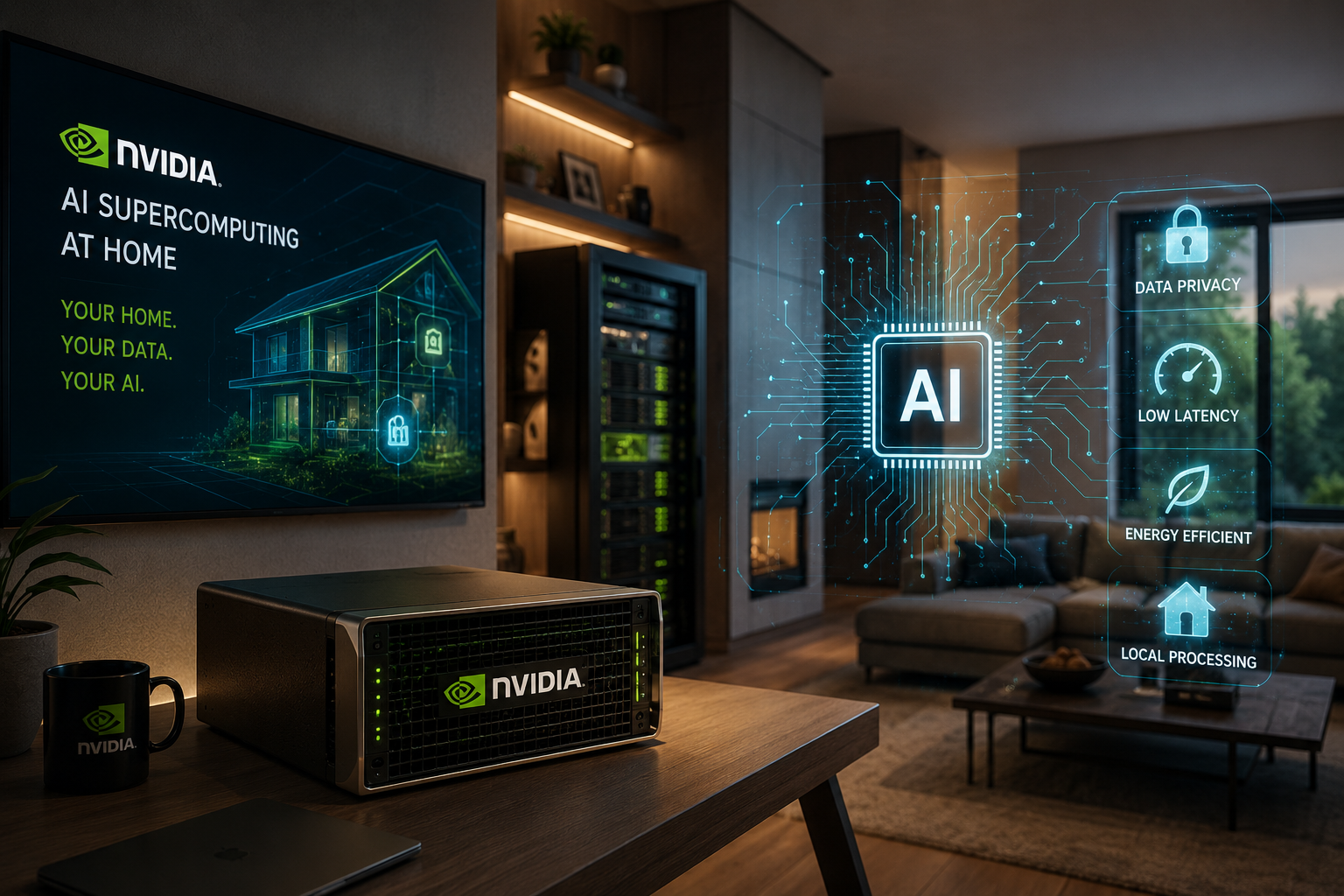
NVIDIA Wants to Turn Your Home Into an AI Data Center
Artificial intelligence has mostly
existed behind the scenes for everyday users. Whether you’re chatting with
ChatGPT, generating images, or using smart assistants, the heavy processing
usually happens inside massive cloud data centers filled with powerful GPUs.
But NVIDIA — one of the biggest companies driving the AI revolution — is now
pushing toward a future where AI runs much closer to home.
And that future may literally start
inside your living room.
Recent discussions online have
sparked attention around the idea that NVIDIA wants to turn homes into
small-scale AI data centers. While that may sound futuristic, the concept is
actually tied to a major shift happening across the tech industry: moving AI
processing away from centralized cloud systems and directly onto personal
devices.
The
Rise of Personal AI Supercomputers
At the center of this movement is
NVIDIA’s growing focus on what it calls “personal AI supercomputers.” These are
compact yet extremely powerful systems capable of running advanced AI models
locally instead of depending entirely on remote servers.
One of the most talked-about
examples is the NVIDIA DGX Spark, a desktop-sized AI machine described by the
company as an “AI supercomputer on your desk.” Designed for developers,
researchers, robotics, computer vision, and advanced AI workflows, the system
allows users to process large AI tasks directly from local hardware.
This marks a significant change from
the current cloud-first AI model. Instead of sending every request to distant
data centers, future AI tools may increasingly process information right inside
your home.
Why
Tech Companies Are Moving Toward Local AI
The push toward local AI is not just
about performance — it solves several growing problems facing the AI industry
today.
Lower
Costs and Reduced Energy Pressure
Running large AI models requires
enormous computing power and energy consumption. Global data centers are
expanding rapidly, placing heavy strain on electrical infrastructure worldwide.
By distributing some AI workloads onto personal devices, companies can reduce
cloud costs and ease pressure on centralized systems.
Better
Privacy and Security
Privacy has become one of the
biggest concerns in the AI era. Cloud-based AI systems often require personal
data, conversations, emails, or images to be processed remotely. Local AI
changes that equation by keeping sensitive information on your own device
instead of constantly sending it to external servers.
For users, that means greater
control, improved security, and more trust in how AI handles personal data.
Faster
AI Experiences
AI systems running locally can respond much faster because they eliminate the delay caused by internet-based cloud processing. This opens the door for real-time AI assistants, smart home automation, offline AI tools, wearable devices, and intelligent security systems with near-instant responses.

Could
Homes Become Mini AI Hubs?
According to recent reports, NVIDIA
is also exploring distributed AI infrastructure through partnerships with
startups like Span. The idea involves installing small AI-powered
infrastructure units alongside home electrical systems to help support AI
workloads using unused residential energy capacity.
These systems, reportedly called
XFRA nodes, could eventually allow computing power to be spread across
thousands of homes and small businesses instead of relying only on giant
centralized facilities.
At the same time, NVIDIA’s latest
hardware — including the DGX Spark and RTX 50-series GPUs — is being designed
for the next phase of AI: Autonomous AI Agents.
Unlike today’s basic assistants,
future AI agents could independently manage calendars, monitor home security,
optimize energy usage, handle finances, and coordinate smart devices
continuously — even without a stable internet connection.
To support this safely, companies are increasingly investing in local inference, where AI processes information directly on personal hardware rather than through constant cloud communication.

The
Future of AI May Live at Home
NVIDIA likely doesn’t expect every
household to install server racks in the basement. However, homes may gradually
become filled with AI-powered devices quietly processing data locally in the
background.
And NVIDIA is not alone in this
vision. Companies like Apple, Microsoft, Google, and Qualcomm are all heavily
investing in “on-device AI” and “edge AI” technologies. From AI-powered PCs to
smart phones and wearable devices, the industry is rapidly shifting toward a
future where AI becomes more personal, private, and locally powered.
Just as gaming PCs evolved from
niche technology into mainstream household devices, AI hardware could follow
the same path over the next decade.
The future of AI may no longer live
in distant server farms — it may soon operate quietly from inside our homes.